
Rocks for Noah, who went back to 'Brick and Mortar' school. I dropped them in Ellensburg yesterday.


She
Will not answer her father's text messages.
Will not notice the leaves changing color.
Will not make a snowball with her cold hand and wish she had cocoa instead.
Will not greedily and thankfully gulp water to sate her thirst.
Will not slam her bedroom door and wonder why she is living with her mother, still.
Will not ever wonder if the vaccine did it.
Will not ever again hide her face with one arm and coyly smile at the camera.
She, Linden,
Will not answer her father's text messages.


Narrative upcoming: How The Queen of Spades knocked me out, cold.

Ellensburg Kiddies’ Parade was a highlight for all the youngsters in my small town. These costumes, painted by mother and Sharon Kibler were our favorites, by far! Notice the knee area on the Queen of Spades where mother, in hindsight, cut space for young knees to bend.
Pictured left to right, Diane Ray, Nancy Kibler, and Cheryl Ray.


——An email to a friend-
I have a story for you, it was like we were in wild kingdom! Last night around 10:00 p.m. Rick and I took the dogs out as he was leaving. We stepped across the alley when suddenly there was a swoop and beating of wings coming out of the alley, very near us.... descending upon us and then clunk, a heavyish-felt sound. Ka-thunk. Just Ka. Thunk.
And then whoosh off it flew, heavy wings lifting it up slowly without it's dead body in tow.
It took a second to figure out what had happened—the whole thing happened so fast.
I guess we upset an owl who was in the middle of hunting and eating a small hawk. It swooped down towards us and dropped its prey and flew off. The hawk was almost dead it was just kind of twitching it was so gross it made me sad I didn't understand it--because I have never seen anything like that so close. I thought it was a rat at first it was so heavy and big.
That's my story and I knew you'd appreciate it since you know what happened to Tank's mother (the owl ate her)... It crossed my mind that maybe the owl decided it wanted Tank instead of what it had and dropped the hawk to grab a Pomeranian instead—losing both (Aesop told it: http://read.gov/aesop/026.html)
Okay that's my story—it seems incomplete, but it really revved me up last night you should have seen me jumping up and down, screaming in a whisper so as not to bother the neighbors.
I wrote that on September 17th, 2020, and tucked it away, hoping to revisit it later. A weekly date had finished with a beau minutes before. It had not been a satisfactory end. I was just thinking to myself. "He has his priorities and they do not include me. He will never think of me as part of his life, but rather a responsibility to fulfill, a drag, pulling him away from his life." And so, because I expected to be his happy priority, as he was mine, I had just decided then that we should probably end it, and to me, this realization was painfully dramatic. As the dogs and I walked him out I felt the owl was giving testimony.
“If you don’t stop now", the owl said, “the relationship will eventually drain you of all energy, exhaust you, essentially drop you in the alley as dead as this hawk."
Fast Forward to Friday, August 7th,2021. The Delta Variant has just swooped into Ellensburg spiking numbers 103%, and we were barely aware of it because we are, of course, vaccinated. It wasn’t as late in the evening, but it was in the same spot, when the owl checked in, this time with his approval, I thought. My spirits were high and I was invigorated, surrounded with the love of some good friends heading out for an extra fun walk.
The owl swooped down the same path as before, just over our heads, but with empty talons this time The previously mentioned beau now just a friend, joined us later that evening for lighthearted fun and we parted politely at the end of the evening, each of us the priority in our own life.
So here I am, almost a year from the first incomplete owl story with what joyfully felt at first like a complete story to tell. I’m guessing it’s not really the whole story.

One of my very early rocks, painted in 2017, looks like the owl who is now my wise neighbor.
My One True Sentence: A Reflection on Hemingway and the Hidden Self
I painted this rock after watching a PBS documentary on YouTube about Ernest Hemingway (https://www.youtube.com/watch?v=swAQ5HfLLIk). The film left me thinking not only about Hemingway’s literary influence but also about the private pain he carried—and ultimately succumbed to. He was a disaster in his final years, tormented by mental and physical decline, and he died by suicide.
Hemingway lived hard. He drank heavily and suffered at least nine major concussions throughout his adventurous life. The rock I painted—left outside the Brick Road Bookstore in Ellensburg in July 2021—is an expression of the part of Hemingway he tried never to show. We all have a side like that if we are human, and perhaps we’re right to keep it hidden. It’s ugly. Vulnerable. Sometimes unspeakable.
And yet, Hemingway was adored. Revered. He reshaped American literature. He believed in showing rather than telling, in crafting writing that allowed readers to experience emotion through sparse, honest prose. Since then, English teachers like me have urged the same from the young minds in their classrooms.
He’s also remembered for this iconic piece of advice: “All you have to do is write one true sentence. Write the truest sentence that you know.”
You might expect, as an English teacher, that I’d be drawn to his writing style. But honestly, I never connected with it. Reading Hemingway felt like being drunk—disoriented, distanced, unmoored. And since I don’t enjoy being drunk, reading him was never enjoyable for me. That, ironically, proves how powerful a writer he was. I accept that about him, even if I don’t personally admire his work.
But what is the lesson I take from the life and death of Ernest Hemingway?
I’m not judging; I’m analyzing.
First, there was likely a genetic component to Hemingway’s struggles. Mental illness ran deep in his family—four of the eight members of his immediate family died by suicide. That tragic pattern suggests inherited vulnerability. Additionally, Hemingway was diagnosed with hemochromatosis, a genetic blood disorder that can cause fatigue, depression, and cognitive decline when iron builds up in the body and damages organs, including the brain. Though it was never treated in his lifetime, the disorder may have compounded his psychological suffering. Together, these inherited conditions created a biological storm that likely fueled both his physical deterioration and mental anguish.
Second, Hemingway’s numerous head injuries almost certainly contributed to chronic traumatic encephalopathy (CTE), a degenerative brain disease linked to repeated concussions. Dr. Andrew Farah, in his book Hemingway’s Brain, documents at least nine major head traumas Hemingway sustained during his lifetime—from a World War I bomb blast to multiple car accidents, falls, and two plane crashes during an African safari in 1954. In one crash, Hemingway reportedly used his head to break open a jammed door to escape the wreckage. CTE is now known to cause memory loss, emotional instability, confusion, and depression—symptoms Hemingway exhibited in his later years. It’s a sobering reminder of how physical trauma can silently accumulate and shape a person’s life and death. I believe this knowledge should shift America’s love affair with football. But it hasn’t. (Learn more here: https://concussionfoundation.org/CTE-resources/what-is-CTE.)
So, what do I conclude? What is my one true sentence?
People are strange—most of us recognize what’s destroying us, acknowledge its harm, and still keep moving toward it, as if powerless to stop.
That’s the part of Hemingway I see in the rock—the side he tried to hide, but that still found its way into everything he wrote and eventually overtook him.
PLEASE RESPOND IN THE COMMENTS SECTION:
WHAT DO YOU THINK?? Do you do this? Why do we as a society or as individuals, continue behaviors that could literally destroy humanity?

Just a thought—Sanitary napkins aren’t very sanitary, are they? They are super gross. A big, thick bunch of paper product wadded up between the sweaty thighs of a menstruater. Ew. Blood gushing out. She can feel it as it leaves her vagina! Right there in front of everyone. It kind of goes…PloP…but she reminds herself there is no need to panic. She has no tampons in, so it’s not a leak, it’s just an earth shattering ‘PloP’. The thick lining of her uterus, devoid of its purpose, removes itself—PloP right into the awaiting sanitary napkin— in front of everyone.
She suspects there’s a smell, too, from the extra attention she’s catching from the boys. "No Big Deal", says the tampon commercial as the bikini clad teen frolics about joyfully.
To accept the bloody wad, she sometimes imagines she’s riding bareback or with a saddle-pad put there expressly to catch the rotted lining of her uterus. But no. She’s just walking down the hall, thinking that it’s time to use a tampon.
A tampon.
Someday she will stick a wad of dry white cloth up there instead. Or use a pretty pink plastic tool meant to shoot it up there painlessly…bearing teeth that will bite if her aim and touch is off.
Then, she has learned that if she feels that PloP, she will know for sure there is blood running down her leg, reminding her for better or worse that she has not made a baby this month.
These two rocks depict her cycle and her visitor.
Aunt Flo visited every 28 days which she either hated or appreciated deeply. It was never ‘no big deal’ like she said. It was an emotional and physical event that happened in broad daylight, her power and her handicap. Like a magic fairy, taking a shit in public.

I have learned from teaching that a captive audience is not always a willing one, which takes away some of the fun of communicating. I find painting and leaving rocks as a gentle way to impact a willing mind.
When a person picks up one of my rocks, it's their choice, and whether or not they keep it or toss it aside doesn't matter. Either way, they decided it themselves.
When they find the rock, are they feeling worried? Scared? Grief stricken? In love? Victorious? Bored?
Whatever they are feeling, the ‘found rock’ can possibly soothe, distract, remind or otherwise participate in the moment.
I leave these rocks around town with the intent of adding a dimension to life.
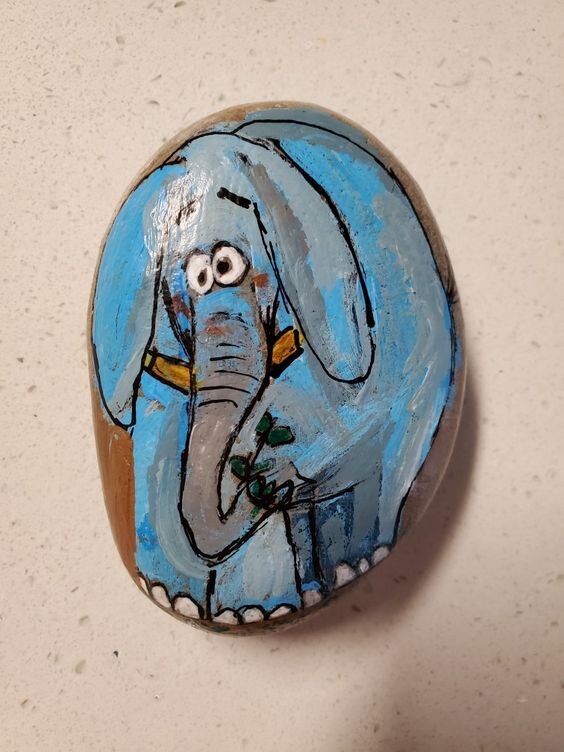
I left this rock in the Art class at Ellensburg High School today.

Once Upon a Time, I did a thing and it was right.
But Once Upon has passed upon a day and then a night.
Followed by another one ‘til Once Upon ‘aint right.
And now with full attending this,
life takes it’s next direction.
today will someday be remembered
as Once, and —with affection.
cray 2021

Here are four rocks I photographed and made into shiny thick coasters in May, 2021. I sent the coasters to my longtime friend Suzanne, who has recently begun to feel like an artist herself.
The heart rock is one of my bigger ones, about 4x3. It is an unusually heavy one, which was perfect at the time. I felt all hearts were heavy in May 2020. I left it on a trail post at Carey Lake, and I imagine a lonely hiker picking it up (It was Covid time, everyone was lonely).
Then John, Just John is a more recent drop. In April, I left him near the entrance to the local Moose Lodge. He sat there quite some time. Having been dropped and broken in half the month before, he was not quite himself. All through April, he watched the lodgers come and go each weekend night, and he questioned his worth and was sure nobody was going to love him, ever. It was at least three weeks he waited, then went home with a Moose, who drifted out reluctantly at closing time, and furrowed him away in a pocket. I imagine he stayed in that pocket until the agitation of the washing machine jerked him out. Now he lives there at the bottom of the machine, waiting again, to be found, this time as a plain-scrubbed rock who thinks of itself as John.
Ms. Thing, well she was hot. I left her outside a grocery store where I often see employees sitting on the curb, smoking. I wonder if they dream about angry customers fighting over masks. She was adored and scooped up the same day, and I imagine her on a bathroom countertop where she watches someone brush their teeth twice a day. She is always straining to see herself in the mirror.
Tiny red heart, well, that one could be anywhere. I gave it to my ex as a token of my forever feelings.
It’s probably been thrown down an alley. Hearts are resilient.
The line is from a poem I wrote about friendship in 1990. The point is that I, like MLK and Oprah, believe that Love will win. It seemed to fit with this rock. The rock was not meant to be a sad Jesus, but it seems to be. A representative of humanity betrayed, anyway.
Thanks Shutterfly.

When travelling, one never imagines they will hurt themselves or need to see a doctor, so this was an enlightening trip for me.
One summer I travelled with some of my students for fifteen days in the British Isles. I was the chaperone on a group tour. Little did I know I would learn an important lesson about healthcare in another country. The students were thrilled when our tour joined another group, and they made new friends. This tour took all day, with the most exciting stop at Gretna Green, which is now one of the most popular places for weddings. Gretna Green is a small parish on the border between England and Scotland. Historically, (following the 1754 Marriage Act which prevented couples under age 21 marrying without parental consent), couples would run away from home to get married at Gretna Green. My students went from being newly introduced to the other travelers, to pretending to marry at Gretna Green.
Afterwards, they noticed a nearby forest, that intrigued their imaginations and they insisted on setting down a dark path. The trees were low hanging, they hung just high enough to allow animals and short humans down the path. It became darker and darker with every step, I instructed them to stay close together and soon we turned back. I was the tallest, and the leaves on the trees brushed over me like the brushes on a carwash. As we left the wooded area, nobody noticed the tiny creatures who jumped onto my clothes, and we all headed to our hotel rooms for the night. In the middle of the night, I nearly shot out of bed—there were tiny bugs crawling all over my back! The innkeeper moved me into a new room and laughed when he saw them, saying I shouldn’t have gone into the woods without protection against ticks. (ticks are parasitic arachnids that live in underbrush).
In the morning, we headed out and by noon I began to feel feverish and woozy and noticed a few swollen purple bumps on my back where the bugs had been. Unfortunately, the heat made everything worse--the pain, the nausea and fever in my body, and I finally gave in and asked where I could find and emergency room. How would I pay for it?
Exhausted, I finally arrived at the Royal Infirmary of Edenborough, and the kind doctor told me I had infected tick bites, and I would need medicine. I was relieved that it wasn’t more serious, but so nervous about the bill, and where to find a pharmacy for the medicine. I was very surprised when they handed me the medicine and informed me that there was no bill. Gratitude and relief washed over me: all of it was paid for by Scotland’s socialized medicine. I learned a lesson I would never forget. Healthcare in Scotland is much different than in the US. Also, never go into the forests in Scotland without protection from ticks.
https://www.mountaineering.scot/safety-and-skills/health-and-hygiene/ticks#:~:text=They%20can%20be%20found%20all,year%2C%20but%20particularly%20in%20summer.


“One’s destination is never a place, but a new way of seeing things.” – Henry Miller. Take for example, Nancy and Cheryl, two neighbor girls, who were sure their chores at home were the worst burden of all. One summer Nancy and Cheryl were sent to the Jackson’s mountain farm, and when they came back, their minds had changed.
They both lived comfortably in a small town with a mother, father, and siblings. Dutifully, they did their chores every day before going out to play. When the postcard came from an old friend of the family, inviting the children to visit, both girls jumped at the chance. The girls imagined a vacation with goats to pet, burros to ride, bright gardens and friends. They smiled as the bus travelled along the flat roads of the Colombia Gorge. They were off to a wonderful vacation, far away from their life full of household chores and siblings. Soon the cliffs and scrubs disappeared as Ponderosa Pines and mountains appeared.
The bus stopped in a tiny mountain town, and they were met by a scantily dressed family. Two toddlers, a baby, and their exhausted mommy and daddy. The heat was harsh, and the baby was bare bottomed. The old farm truck groaned, and the gears scraped as they drove on a narrow, winding mountain road that seemed to go on forever. The girls began to wonder about this wonderful getaway.
The family lived in old barn, which was destined to be a house, when there was money to fix it up. Someday it would have a kitchen, a bathroom, and a heater in every room. For now, without electricity, it had none. Up the mountain a way, there was a small cabin the girls slept in, with a special garden out front. The garden--full of weeds to be picked, the cabin, full of mice. To wash up every morning, they trekked down past the goat barn, over the creek, to a water pump. It took all their strength to get the icy water to fall into their buckets. Then, they lugged the water up to the barn for the family.
Cheryl and Nancy were up with the sun, squatting on a three-legged chair with their heads in the side of a goat with bursting teats. Their hands ached from pulling the huge nozzles, until the bag was empty. Gratefully, the goats wandered out in the fields, then back again before supper for the same. By the end of the two weeks Cheryl liked the smell of her sweat against the goat fur. The small children needed tending constantly, except when the girls were needed to scrape the bark off the felled trees for a new house.
Nancy and Cheryl were never so happy to come home again! Home, where each was the youngest in their family, and their homes had running water and electricity. If they learned anything on this trip to the mountains, it was to be grateful for what they have.

“Man. Rick Talerico, you know….everyone who knows you…doesn’t not like you," gushed a completely sober Ellensburg native, struggling verbally to express the essence of Rick.
But it goes even deeper than being liked or not NOT liked. Rick is an icon in the underbelly of Ellensburg night life. He has been feeding and entertaining Ellensburg for 25 years.
He is a riddle, wrapped up in an enigma, and you can see this as he steps away from his work or play for a smoke, and a visit.
His low, Taurean bearing exemplifies his character--stubborn, unforgiving, and potentially dangerous. Whereas, his charming, gruff voice and impish, chin-tucked grin combine with his thick, luxurious chuckle, to draw you into the warmth of his persona, immediately. Intellectually, he has a direct and startling connection between the topic at hand and his own funny bone. Then there is the sensuous and symbolic quality of the way he half-closes his eyes to protect them from the smoke he makes. He turns cautiously away from the group so as not to be rude with his habit. He is complex.
While he loves competitive games and has forged long friendships, Rick is essentially a loner, and a bit of a genius when it comes to movies and music. He draws his words and his convictions from the well of popular culture. He would be happy to see most people… never, and some lucky people, occasionally. A special someone, a loved one in his life, will know for certain that there is a delicate and perpetual place for her in his life, somewhere between his well-guarded private time and his kitchen. In the kitchen, he is the boss.
He is the lone puppet master in the kitchen at The Tav, but he doesn’t abuse or treat others unfairly, as you hear cooks or chefs will do. He is efficient and unafraid of hard work, and expects the same from others as well—which may not be a reasonable expectation in a job offering such low pay and high stress.
The college students working there have their eye on life after The Tav, and hold their upcoming graduation as a carrot to get them through the night. If they work hard, they tell him apologetically, it is to make sure they don’t end up like him, 50 years old in a job at The Tav. But he has a degree in Graphic Design that came from the same college they fervently hang their hopes on. A degree offered him stability but came with creative bondage, and he trudged that route for a few years before returning to his kitchen
What they may not realize is that—this was an easy and deliberate choice for Rick. His creative needs are fulfilled by the rhythm of orders coming in, the juggling of unexpected demands handled deftly and with surprising alacrity. His reward is timing and style and the appreciation garnered.
He is essentially free here, at the Tav, and he is content.
I am proud to have been a special someone in his life for 17 Thursdays, and before. When I was 12 and he was six, I taught him to draw a horse, and then ride one. He taught me how to care for a bloody nose and a feisty boy. And now, 43 years later, I see the same feisty boy who throws his hands in the air to signal victory, now a man. I watch him from this silent side of the wall between us. Immutably, he is living his life with a unique combination of humble acceptance, self-deprecating pride and bitter self-preservation.

"I have no reason to wear a beautiful dress. None." came the mournful whimper.
The world weary woman was drinking heavily and she was not alone In fact, the existence of this crowded outdoor drinking hole seemed to be diametrically opposed to the fact that there was a Covid 19 pandemic. Drug use and alcohol abuse was up, endemically, and she was participating in the tendency, slobbering her ideas, and unknowingly, the virus, from one end of the table to the other.
Tears were streaming down her face but because of the pandemic’s demand for mask wearing in public, there was no make-up to be ruined, so that was something. She was certainly wearing no mask now, nor were the others, because there was a rule that if she was outside, or sitting down, she didn’t have to wear one.
"I have no reason to wear a beautiful dress. None."
And as she spoke, she draped herself over the others at the bar. She trusted that her Drunkeness protected her and the others at the bar, and the virus smiled at the opportunity to grow. It would grow stronger and reach farther than any of the other COVIDs would. And this time, it had the idea of a dress to thank.


Egyptian Baby Blue Hippo, mine.
https://www.metmuseum.org/art/collection/search/544227
I'm not sure what it is I like so much about this ancient Egyptian statue of a baby hippo, but it intrigues me. I think I like the shadows from the Nile, right on his back, they give you an idea of the setting, which immediately suggests a story. And the hippo may be the main character, dynamic and anthropomorphic, or flat and quiet, in the background of the excitement of that time. Maybe the reed cradle bumped the baby hippo as it floated by with baby Moses. Imagine that.
Five of these rocks have been dropped around Ellensburg, but I kept this one.

This rock tells a story of love.
There was a once boy who had lived for nearly 50 years before he found the love of his life —he found his true love while hiking Manastash (prounounced MENastash) Ridge, in Ellensburg, WA.
Because he could, he strapped a 50 pound bag on his back, to remind him that he was still strong, still alive, still capable of handling great weight.
The heat was almost, but not quite, unbearable (100 degrees, or so) and he focused on the sharply escalating trail in front of him. When at last he reached the top, a golden-haired angel helped him give his Dog some water. She smiled. She talked with him not at him. She too was hiking the ridge at an inhospitable time of day. She was like no other. They shared air and steps all the way down the ridge.
He knew then he would give her all the apricots in his orchard. He knew she was his love, and soon she would realize it as well.


A character named James Cady was my Jim over here in the 90's. (Coincidentally I also had a Jim doing my hair on the west side in the 90's so I had two Jims to access at all times, and I was very proud of it). He took care of my hair and he made me look beautiful. As it does, time passed and I moved around-- we parted ways but I never stopped loving him for what he did with my hair.
He passed away this week unexpectedly, a man younger than myself died of a cardiac arrest. Kathy and Scott Carlton still went to Jaymes and are feeling the loss more than me, no doubt. It's just a shocking loss in a small town. These rocks are my expression of one of his own pieces of art that was hanging in his studio.
You did good, Jaymes.
It was orange and brown; a warm nylon/Polyester jacket, down- filled to keep away the Ellensburg wind. It engulfed little Ricky, making him feel ridiculously small and silly, and he was determined to lose it at school that day. It was easy, the spring sun shone down and the coat stripped itself off, anthropomorphically, landing on a recess bench, forgotten.
42 years passed, and the coat returned to him, turned inside out, and named Cheryl.
She was still orange and brown, but now She fit him perfectly. When passing a mirror, he caught a glimpse of his figure with Cheryl on, and liked how he looked. This time, he would cherish her, and with any luck, she would not be lost.


Thursday, I joined a rally (not an organized demonstration) in front of the court house. I like this definition of rally: “an arousal from depression and weakness.” The rally was a lively gathering of citizens attuned to current events. Taxpayers less weighty than most of the white people in town. Me, I’m a white person in town.
Police blocked the street and re-directed traffic; peaceful participants. I soaked in the feeling of unity. I basked in the energy of “Yes, we can.” I was not ashamed to be white.
Returning to my nearby apartment, I found two officers in an unmarked black SUV, talking shop with two bike cops from CWU. They laughed and chatted. Fat, white and relaxed. I went in, got my dogs and came back out. My pets were suspicious, but one officer laughed and talked to them, and they quickly relaxed. So did I. I had barely taken twenty steps on my usual evening route when a menacing figure suddenly blocked my path.
The reverse of the friendly cowboy. Rifle ready out in front of his chest, his body rigid, silent, terrifying. “I can kill you” was his harsh non verbal message. Shaken, I screamed a few profanities and the rifleman stepped aside, keeping his stiff military bearing. Job done.
The nearby police did not seem concerned. They approached me and asked “Ma’am, can we help you?” “Do you see him? Did you see that gun? He cut me off with his gun up. Why are you ok with that?” “Ma’am, it’s his right.” “It’s his right to scare a person walking her dogs? That is his right?” “Yes ma’am.” “Are you kidding me?” “How can I help you with this Ma’am, would you like me to walk past him with you?” “No. I would like you to do something about him stepping out in front of me with a big rifle up like that. That’s his right?” “Ma’am, I can empathize with you, but yes, that is his right.”
I was born here. I am a fan of cowboys. But yesterday I saw the police in my town protect a man’s right to bully while bearing arms, over the rights of a person to feel safe walking her dogs. Ask yourself, please: what if that man had been black with a menacing demeanor and a gun jutting out angrily at me? Would that have been his right, too?
What I saw is hope. After six weeks with the town locked down, I got out for a ride.
On my bike this morning around town, I saw people smiling. I saw people caring about each other. Moving carefully past one another with their concern visibly aimed at another person, outside their bubble gently and kindly, respectfully and appreciatively. Some masked, some not, all deferring to one another. And my heart went into my throat.
What I saw today is hope.
Cray
